No records, no defence
In 2026 the Supreme Court rejected three defences that every AMC company in India uses. The accident was in 2003. What settled it was not the brake. It was that the contractor could not produce a logbook its own contract required. Here are the seven records behind the court's reasoning, on one page.
One page. No card. Unsubscribe whenever.
Read them in your own company's voice, because that is where they come from.
"It was the customer's staff."
The technical report agreed. During the rescue, someone in the machine room released the brake with the power off.
The court's answer: the only reason anyone was in that machine room is that the lift had stopped between floors again, for a reason the contractor had known about for eight months. The cause of the accident is not the cause of the case.
"Our mechanic was not on duty at that hour."
A reasonable thing to say. It needed one document to prove it.
The contractor "produced no attendance register, duty chart, log book, or other contemporaneous record". Its own contract required all of them. Their absence, the court said, "does not assist its case".
"We told them in writing."
It had. It wrote asking for a voltage stabiliser. Nobody installed it. Nine breakdowns of that one lift followed in two months.
The court: it should have "followed up on this recommendation", "declined to certify the lift as fit for continued use", or "escalated the matter". Writing the letter was not the end of the duty.
That contractor was also the manufacturer, so its share is not every AMC company's share. But the reasoning is written for everyone: a party that undertakes the comprehensive maintenance of a lift owes a heightened duty of care to its users. The building was held liable too, partly for not keeping the registers that would have shown whether the mechanic ever turned up.
Not best practice. The documents the judgment names, and the ones your customers now have a legal reason to ask you for.
The document that answers "was your man there?" without an argument.
Per lift, not per site. A site-level tick proves nothing about the unit that failed.
Your signature is a claim. Theirs is evidence.
The interval in the contract, evidenced at the interval. Not reconstructed at renewal.
Response time is only a promise until something records the clock.
This is the one that failed here. The letter existed. The follow-up did not.
Recorded, dated, named. Otherwise the rescue attempt becomes your problem.
Each record carries the clause or the paragraph the court quoted, what to put in place this month, and which states already require it in their own Act or Rules.
Verified against the judgment text and against the lift Acts and Rules of 15 Indian states, read in September 2026. Not from secondary reporting.
Send me the checklist →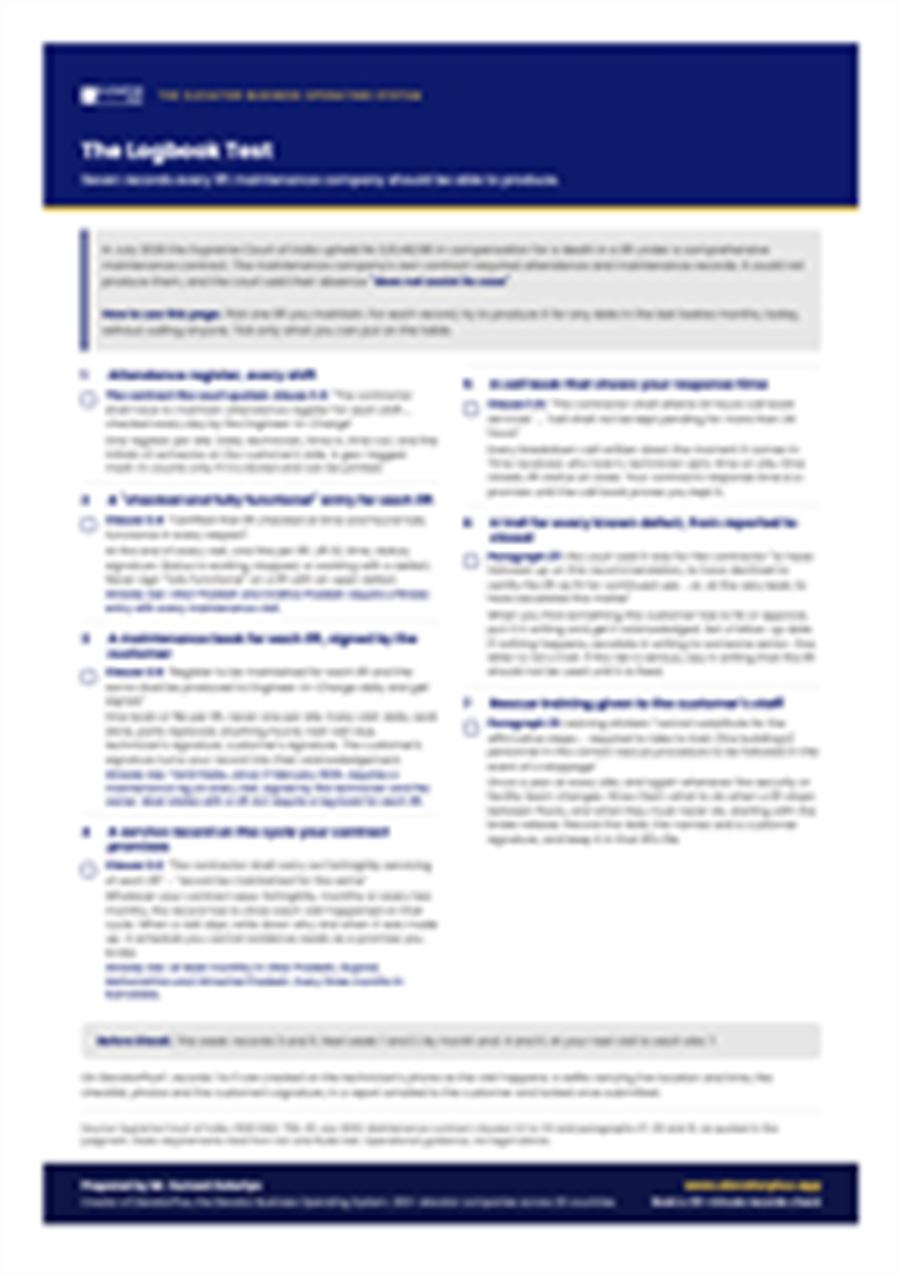
Elevator companies running AMC and service books in India, where a customer can now reasonably ask to see what you did and when.
Owners and service heads who suspect the answer to "can we produce twelve months of visits on any one unit, today, without a search?" is no.
Anyone who has ever closed a service visit on a phone call and written it up on Friday.
Not for you if you already hold a signed, per-unit record of every visit going back three years. In that case you do not need this. You need to be telling your customers you have it.

Creator of ElevatorPlus, the Elevator Business Operating System used by 200+ elevator companies across 20+ countries, and author of ElevatorPlus: How to Run Your Elevator Business Operations Stress-Free and 3X Your Growth.
This checklist came out of reading the judgment and then reading the lift Acts and Rules of 15 states to see who already requires what. Most published commentary on this case gets the records part wrong, which is why every line here carries its source.
What your office writes down this month is what defends you in 2049.
One page. No card. Unsubscribe whenever.